
How much do AI agents really cost? 2026 figures and a method

For a coding agent, Anthropic reports about $13 per developer per active day for Claude Code, or $150 to $250 per month. Several agents in parallel multiply that figure, and 85% of companies misestimate their AI costs by more than 10%. The right measure is not the monthly bill but the cost per accepted delivery.
The cost items of an AI agent team
The most visible line in an AI agent team's bill is the model's subscription or API: input, output and cache tokens, at rates each provider publishes and that vary sharply from one model to another. But that single line tells only part of the story. The human time spent framing and reviewing work, the redone work after a rejected delivery, and the tooling that runs around the agents' work weigh just as much on the real cost, often more over time. Ignoring these items is like managing a budget by looking at a single line of the bill, and discovering the rest at the most uncomfortable moment: the end-of-month statement.
Running several agents in parallel amplifies several of these items at once, not just the token one. According to the Claude Code documentation, an agent team in plan mode uses about seven times more tokens than a single session, because each agent reloads its own context and coordination between agents adds further exchanges. Human review time follows a similar curve: more agents running in parallel means more deliveries to check in the same window of time, not automatically faster unless someone adds review capacity to match. Parallelism saves time on a project, rarely money on the full bill, unless you treat it as a conscious trade-off rather than a reflex applied to every ticket.
The cost of tooling around the work grows with the number of agents too, even if no one thinks about it when signing up for a model subscription. Ticket orchestration, storing the exchanges between an agent and a ticket, and the continuous integration that checks every delivery before merging it all consume resources independent of tokens, but necessary for the agents' work to stay traceable. A team that only budgets for tokens often discovers this item at the same time its hosting or continuous integration bill climbs with the number of tickets processed each month.
- Model subscription or API: input, output and cache tokens, at rates that vary by provider, by model and by context size.
- Human framing time: writing the mission and acceptance criteria for a ticket before launching an agent on it.
- Human review time: checking a delivery before merging it, an item that never disappears, whatever model is used.
- Redone work after a failed delivery: a rejected ticket gets redone, so it gets paid for twice, in tokens as in human time.
- Tooling around the work: ticket orchestration, storing exchanges and continuous integration, which run even when no agent is working.
Why cost per token is misleading
Comparing two models on token price alone almost always leads to the wrong conclusion. A model that is twice as cheap per token can produce a rejected delivery half the time, while a more expensive model delivers on the first try because it follows criteria written in advance more closely. Token price measures consumption, not a result. The question that matters is not how much this run costs, but how much it costs, in total, to get a delivery you actually accept to merge.
The right metric is cost per accepted delivery: the sum of the costs of every run a ticket required, divided by the number of tickets actually merged. A ticket that needed three attempts before being accepted should carry the cumulative cost of those three attempts, not just the cost of the last one. It is this division, the cost of runs over merged tickets, that reveals whether a cheaper-per-token model still is once redone work is counted.
Take a fictitious numeric example, built to illustrate the calculation and not to describe a real customer. A ticket assigned to a budget model costs $0.40 in tokens per run; for lack of precise enough criteria, it needs three runs before an accepted delivery, so $1.20 in total for one merged ticket. The same ticket, assigned to a more expensive model but with criteria written in advance and a review before merging, costs $0.90 in tokens and passes on the first try, so $0.90 for one merged ticket. In this example, the model that is cheaper per token ends up costing more once redone work is counted. The exact figure varies by team and by ticket; what does not vary is the need to divide the cumulative cost by deliveries actually accepted rather than by the number of runs launched.
The same calculation scales to a whole team: sum, over a given period, the cost of every run of every ticket, then divide that total by the number of tickets actually merged over the same period. Two teams spending exactly the same amount on tokens in a month can show a very different cost per accepted delivery if one merges twice as many tickets as the other on the same budget. It is this ratio, not the total tokens consumed, that lets you honestly compare two models, two teams or two months. Tracking only total spend, without this denominator, is like comparing bills without knowing what they actually paid for.
The same division applies whatever model provider you use: the list price published on a pricing page never says, by itself, how many runs a given ticket will actually need before being accepted. Two teams using the same model, at the same rate, can end up with a very different cost per accepted delivery depending on how clear their criteria are and how rigorous their review is before merging.
Ignoring this measure has a real cost: according to CIO.com, 85% of companies misestimate their generative AI costs by more than 10%, often because they track total spend without relating it to the deliveries obtained. At Uber, Claude Code usage burned through the year's AI budget in four months before a per-engineer cap was put in place, an example of what happens when spend is tracked monthly rather than per ticket.
The levers that change the bill
Five levers act directly on the cost per accepted delivery, regardless of which model provider you choose. None is enough on its own: it is their combination that brings the bill down, because each one tackles a different cost item from those listed above.
These levers are set before launching an agent, not after the fact: a criterion added once the delivery is done changes nothing about the cost already spent. Prompt caching, for instance, assumes the repeated context stays identical from one call to the next, which favors stable role sheets rather than ones rewritten for every ticket. Choosing the model per role, in turn, assumes you know the real difficulty of each task before deciding, not after noticing redone work.
Each of these levers acts on a specific item from those listed above. Choosing the model per role and prompt caching directly reduce the subscription or API line. Criteria written in advance reduce the human framing time, by avoiding back-and-forth clarification along the way. Review before merging and resumed rather than restarted sessions reduce the share of the budget that goes into redone work, the item easiest to lose sight of until a delivery has actually been rejected. Tracking these five levers ticket by ticket, rather than applying them once at the start of a project, is what lets you see which one weighs most in a given project.
These five levers apply just as well to a small team as to several agents running in parallel across several projects: only the number of tickets they are checked against each month changes. A team just starting out can review them manually, ticket by ticket; a larger team gains from tracking them on a dashboard that ties each lever to a measured cost per accepted delivery, rather than one estimated after the fact.
| Lever | Why it reduces the cost per delivery |
|---|---|
| Model choice per role | Reserve the most capable model for tasks at risk of redone work, and a budget model for simple, well-framed tasks. |
| Criteria written before launch | Less back-and-forth clarification during the run, so fewer tokens spent before the first delivery even happens. |
| Review before merging | An error found before merging costs a review; found after, it costs a fix and a whole new cycle. |
| Resumed rather than restarted sessions | Resuming a session keeps the context already paid for in tokens; restarting from scratch pays for it a second time. |
| Prompt caching | A context repeated from one run to the next, like a stable role sheet, is billed at the reduced cache rate rather than the full rate on every call. |
How Atipol measures it
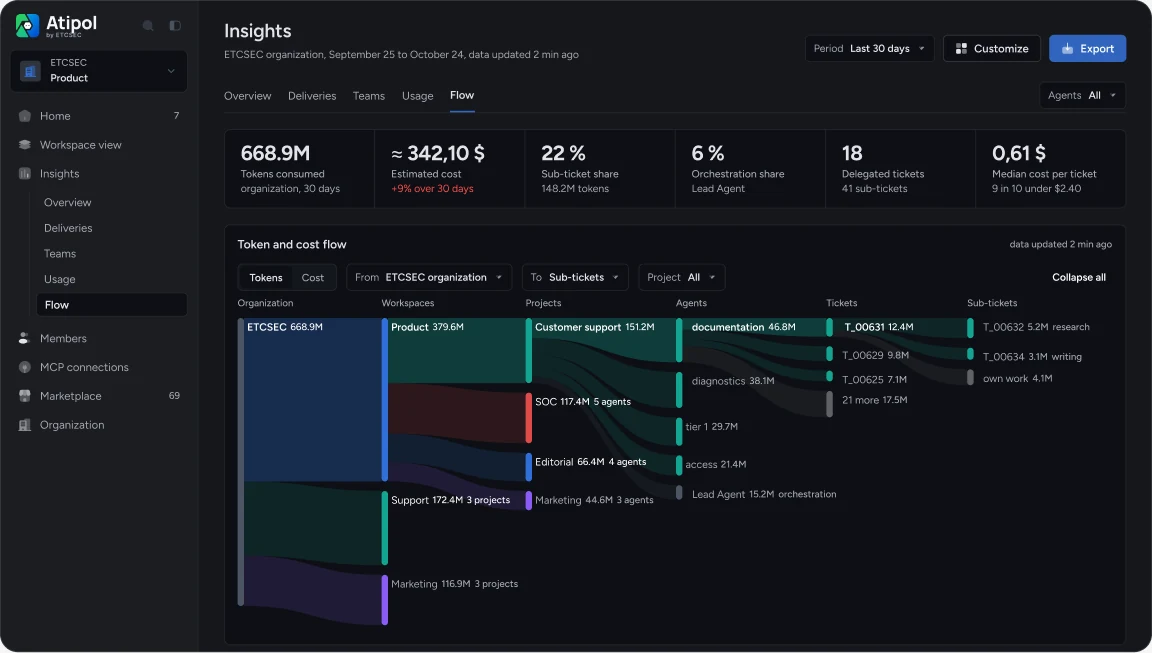
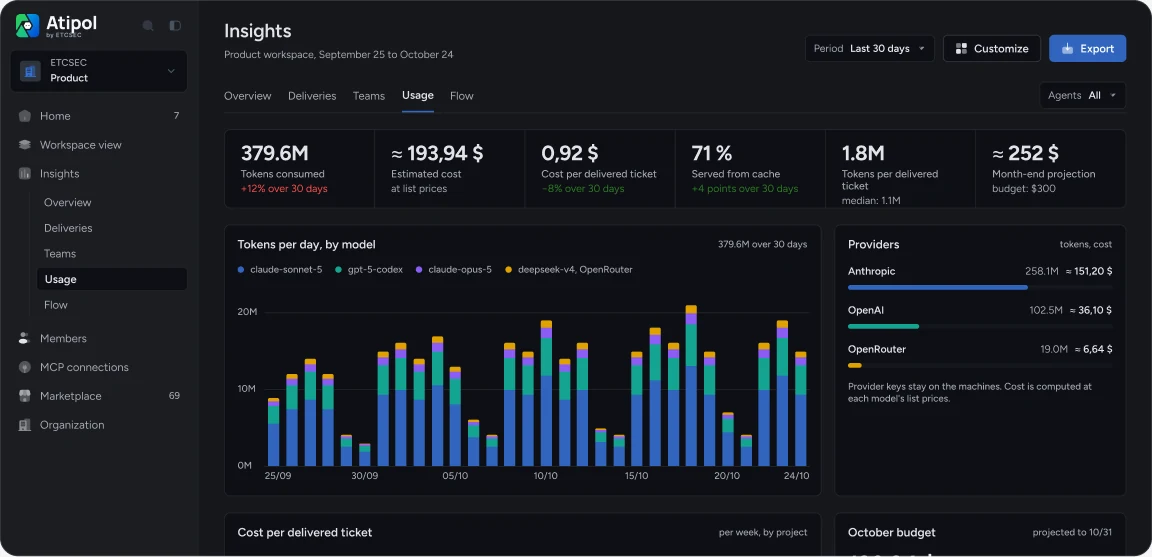
In Atipol, cost is tracked in tokens and in euros by run, by ticket, by agent and by model: you see exactly which item consumed what, from a single run down to the sub-ticket, without waiting for the end-of-month bill to find out. This tracking applies equally to a per-seat subscription, predictable for daily use, and to an API key billed by usage; many teams combine both depending on the role. A monthly budget per provider key is tracked with an alert at a set threshold, so you decide what comes next already knowing the spend engaged rather than discovering it afterward.
This granularity answers different questions. Cost per run tells you how much a single call to the model cost. Cost per ticket adds up every run of a ticket, accepted or rejected, and relates to the number of deliveries merged to get the cost per accepted delivery described above. Cost per agent tells you which role consumes the most in a given project. Cost per model tells you whether the model chosen for a role is still the right choice once redone work is counted, or whether it is worth switching for that specific role. The same tracking also reads by project: an organization running several projects in parallel sees which one consumes the most, and can adjust the budget project by project rather than only at the whole organization's level.
Plans range from Free to Enterprise, by quote. Pro, at €19 including tax per user per month, or €152 per year, and Business, at €39, add the features built for a team running several agents across several projects. Enterprise is discussed by quote for organizations with specific needs, for example a ticket volume or a number of projects beyond the standard plans.
Atipol does not save tokens on your behalf: it measures spend, alerts once it nears a set threshold, and requires an explicit confirmation before switching to a more expensive model, an option you can also forbid role by role. The decision stays human and informed, not automatic. This tracking by run, by ticket, by agent and by model is what lets you calculate, project after project, the one figure that actually matters: the cost per accepted delivery described above.
Frequently asked questions
Does Atipol save tokens?
That is not what it promises: it measures spend in tokens and in euros by run, by ticket, by agent and by model, and requires an explicit confirmation before switching to a more expensive model, an option you can also forbid role by role. You decide knowing the cost, not after the bill.
How do I track spend by model provider?
With a monthly budget tracked per provider key and an alert at a set threshold, so you decide what comes next already knowing the spend engaged rather than discovering it on the end-of-month bill.
Do I have to choose between subscription and API?
No: a per-seat subscription is predictable for daily use, the API bills by usage for occasional spikes, and many teams combine both depending on the role.
What is cost per accepted delivery?
It is the cumulative cost of every run a ticket required, divided by the number of tickets actually merged. It is the metric that reveals whether a cheaper-per-token model still is once redone work is counted.
Does prompt caching really reduce the bill?
Yes, for context repeated from one call to the next, like a stable role sheet: it is then billed at the reduced cache rate rather than the full rate on every call, as confirmed by model providers’ pricing pages.
Which Atipol plans track these costs?
Free, Pro at €19 including tax per user per month (€152 per year), Business at €39, and Enterprise by quote for organizations with specific needs.
Sources
- Claude Code, Manage costs
- CIO.com, AI cost overruns, September 10, 2025
- Outlook Business, Uber, 2026
- Anthropic (Claude), pricing
- OpenAI, API pricing
To estimate exactly what this means for your team, use our AI agent cost calculator.
To connect this cost to a complete framework, see our AI agent governance guide.
The public demo shows a fictional organization at work, no account needed. The free plan includes a project, three agents and an agent lead.