
Agentic AI, GDPR and the AI Act: what applies in 2026 and 2027

An AI agent is neither compliant nor non-compliant in itself: it is how it is used that counts. The GDPR and the AI Act apply as soon as an agent processes personal data or acts in a use classified as high-risk. The AI Act's "high-risk" obligations apply from December 2, 2027 for Annex III and from August 2, 2028 for Annex I.
Why an agent that acts changes the question
A conversational assistant answers one question and waits for the next: by default it has no persistent memory between two exchanges, no access to tools able to act on an outside system, and no ability to decide a next step on its own. An agentic AI agent changes this on three points at once. It can be given access to real tools: reading and writing files, calling an API, sending a message, updating a database. It can keep context across several steps, sometimes over several days, which means personal data read at one step can influence a decision made much later. Finally, it can chain several actions without a person validating each one, which shifts part of the responsibility from the moment of the decision to the configuration that made it possible upstream.
None of these three traits, tool access, context memory and chained autonomy, raises a new legal question by itself: the GDPR applies the same way to automated processing as to manual processing, and the AI Act does not distinguish an agent from a model based on the marketing vocabulary used to describe it. What changes is the surface these traits expose. An agent with access to a messaging tool and a customer database can, in a single task, read personal data, cross-reference it, then act on it: the GDPR question no longer concerns one isolated read but a chain of operations. On the AI Act side, an agent that makes a decision affecting a person, for example screening job applications or scoring risk, can fall into the high-risk classification regardless of the underlying technology.
This is why the two texts now have to be read together rather than one after the other: an organization deploying an agent can no longer treat the GDPR question and the AI Act question as two separate files, since the access scope that satisfies GDPR minimization is also what reduces exposure under the AI Act, and the human oversight the AI Act requires documents, in the same move, part of what a GDPR impact assessment seeks to verify. The sections below detail each text separately, before linking them in a single check-list.
The GDPR applied to AI agents
Before giving an agent access to personal data, the first question remains the one Article 6 of the GDPR asks for any processing: what legal basis does it rest on? Contract performance, legitimate interest or consent cannot be assumed just because an agent automates a task previously done by hand; the legal basis valid for a manual process still has to be checked for its automated version, because the volume, speed and cross-referencing of data an agent enables can shift the balance between the interest pursued and the rights of the data subject. Documenting this legal basis before connecting an agent to a source of personal data avoids discovering, after the fact, that none of the bases listed in Article 6 actually covers the use made of it.
The minimization principle, set out in Article 5 of the GDPR, requires limiting collection and access to the data strictly necessary for the purpose pursued. Applied to an agent, this principle translates concretely into a tool and data scope defined per task rather than a broad access granted once and for all: an agent tasked with drafting a customer reply does not need read access to the entire payroll database, even if nothing technically prevents it. The temptation, when configuring an agent, is to grant broad access to avoid adjusting it task by task; that is exactly the opposite of what minimization requires, and it is also what turns one isolated configuration mistake into exposure of data at scale.
When an agent relies on a platform or a model provided by a third party, that third party most often acts as a processor within the meaning of Article 28 of the GDPR, which requires a contract or data processing agreement specifying the nature, purpose and duration of the processing, as well as the safeguards provided. Checking this agreement before connecting an agent to personal data remains a separate step from the technical review of the tool itself. When that third party or its own subprocessors are located outside the European Union, the general principle for transfers set out in Article 44 of the GDPR applies: a transfer outside the Union requires a recognized mechanism, an adequacy decision, standard contractual clauses or another appropriate safeguard, and this check does not depend on whether the processing is carried out by an agent rather than by conventional software.
The rights of data subjects do not disappear because an agent is part of the processing chain. The right of access under Article 15 of the GDPR applies to data an agent has processed just as it applies to data processed by any other system. When a decision produced by an agent has a legal effect or significantly affects a person without real human intervention on that specific decision, Article 22 of the GDPR specifically governs this case: the person has the right not to be subject to a decision based solely on automated processing under these conditions, subject to the exceptions set out in that same article. An agent that drafts a recommendation later reviewed by a person does not fall into this case; an agent whose output becomes the decision without a real review falls into it directly.
Article 35 of the GDPR requires a data protection impact assessment when processing is likely to result in a high risk to the rights and freedoms of individuals, notably in the case of systematic evaluation, large-scale profiling or processing of special categories of data. An agent that combines several sources of personal data, acts at scale or influences individual decisions often ticks several of these criteria at once, even when each processing operation taken on its own seemed harmless. The impact assessment then becomes the place to document necessity, proportionality and the measures taken to reduce the risk, before deploying the agent rather than after an incident.
The AI Act: timeline, risk levels and obligations
The AI Act's timeline, Regulation (EU) 2024/1689, has been clarified in several steps. The prohibited practices of Article 5, such as generalized social scoring or certain manipulation techniques, have applied since February 2, 2025. The governance obligations for general-purpose AI models have applied since August 2, 2025. The general date of application under Article 113, which notably covers the transparency obligations of Article 50, remains August 2, 2026. The regulation known as the Digital Omnibus, Regulation (EU) 2026/1744, which entered into force on July 27, 2026, postponed the obligations tied to high-risk systems under Annex III to December 2, 2027, and those for regulated products under Annex I to August 2, 2028.
The AI Act classifies systems by their use rather than by their technology. Article 5 bans certain practices regardless of the system used to carry them out. Article 6, combined with Annex III, defines the cases where a system becomes high-risk: recruitment and worker management, access to essential services, creditworthiness assessment, or certain uses in law enforcement and the administration of justice. An agent that automates a recruitment step, for example screening applications before a human interview, can fall into this classification even if it presents itself as a simple decision-support tool; the classification depends on the actual use, not on how the tool is marketed.
Article 50 requires clear information to people when they interact with an AI system or receive content it has generated, for the cases it covers. For systems classified as high-risk, Article 14 requires effective human oversight, with a real ability to interrupt the system or discard an output before it produces an effect. This ability to interrupt only holds if a person has the time, the information and the real right to exercise it: a stop button that exists technically but that nobody ever uses, for lack of time to review the agent's outputs before they act, does not satisfy the spirit of this article.
Article 3 distinguishes the provider, who develops an AI system and places it on the market or puts it into service under its own name, from the deployer, who uses it under its own authority as part of its activities. A company that builds and markets an agent under its own brand acts as a provider and carries the corresponding obligations, notably documentation ones. A company that uses an agent provided by a third party for its own internal needs generally acts as a deployer, with obligations centered on the use it makes of it, human oversight and informing the people concerned. These two roles do not always exclude each other: the same organization can be a deployer for an agent it buys and a provider for another it develops and makes available to third parties.
| Obligation | Date |
|---|---|
| Prohibited practices (Article 5) | February 2, 2025 |
| General-purpose model governance | August 2, 2025 |
| Transparency (Article 50) and general application (Article 113) | August 2, 2026 |
| High-risk, Annex III (postponed by the Digital Omnibus) | December 2, 2027 |
| High-risk, Annex I, regulated products | August 2, 2028 |
Check-list before deploying an agent
The table below takes each requirement discussed above and sets out the question to ask before deploying an agent on personal data or in a use that could classify it as high-risk, along with the concrete evidence to keep so you can answer a question from a supervisory authority or a client auditing the processing. None of this evidence replaces a full legal analysis: it gives a documented starting point rather than a compliance conclusion.
| Requirement | Question to ask | Evidence to keep |
|---|---|---|
| Legal basis (GDPR Article 6) | What legal basis does the agent rely on to process personal data? | The reason documented in the record of processing activities. |
| Minimization (GDPR Article 5) | Does the agent have access to more tools or data than its task requires? | The access scope written for each agent or each task. |
| Processors and transfers (GDPR Articles 28 and 44) | Does a processing agreement cover the agent's provider, and does a mechanism cover any transfer outside the EU? | The signed data processing agreement or standard contractual clauses. |
| Risk classification (AI Act Article 6 and Annex III) | Does the agent's use match a case listed in Annex III? | The classification analysis documented before deployment. |
| Human oversight (AI Act Article 14) | Can a person actually interrupt the agent or discard its output before it takes effect? | The interruption procedure and its record of actual use. |
| Transparency (AI Act Article 50) | Do the people concerned know they are interacting with an AI system? | The information text shown to the person concerned. |
What Atipol provides, and what it does not
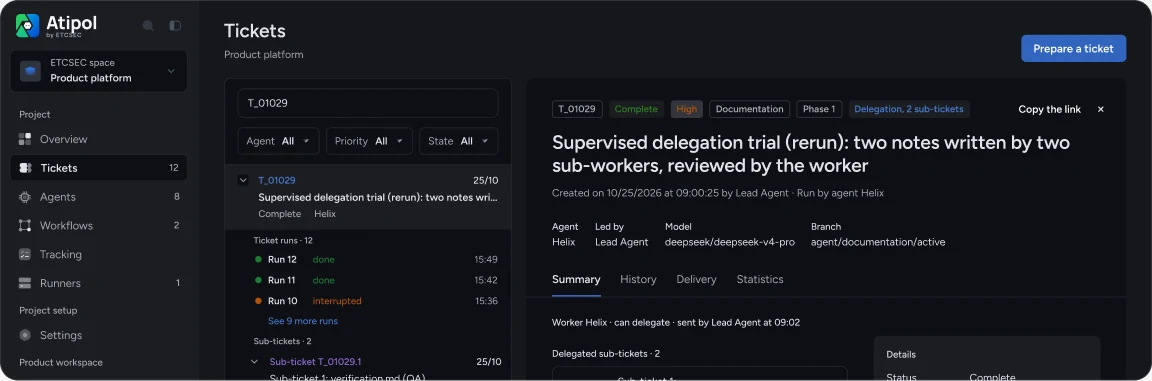
Atipol keeps the history of every ticket and the review decisions that validated it, which gives a record of who requested what and who approved what before an action was integrated. Project content is encrypted under a key specific to the organization, and MCP calls judged sensitive require the explicit approval of the lead agent before execution rather than being executed and logged afterward. Every ticket carries a file scope and acceptance criteria written before the agent is launched, which by construction documents what an agent was allowed to do for that specific task.
These elements provide a usable record for documenting real human oversight and a defined access scope, two concrete expectations of the GDPR and the AI Act described above. They do not, however, make an organization compliant with the GDPR or the AI Act, and Atipol replaces neither an impact assessment, nor a lawyer's advice, nor a supervisory authority's decision. Verifying the legal basis of a processing activity, classifying the risk level of a use, or drafting an impact assessment remain decisions that only your organization, with its own counsel, can make.
Frequently asked questions
Is an AI agent a processor under the GDPR?
The agent is a tool; it is the platform or model provider that may be a processor within the meaning of Article 28. Check your contracts and your data processing agreements.
Does my agent have to comply with the AI Act if it only automates an internal task?
Yes: classification depends on actual use, not on whether the agent stays internal to the organization. A use covered by Annex III remains high-risk even internally.
Do I need an impact assessment for every agent?
No, only when the processing poses a high risk under Article 35 of the GDPR, for example large-scale profiling or systematic evaluation of individuals.
Have the AI Act's high-risk obligations been cancelled by the Digital Omnibus?
No, postponed: to December 2, 2027 for Annex III and August 2, 2028 for Annex I. The postponement buys time; it does not remove any obligation.
Who is the provider and who is the deployer when using a third-party agent?
If you develop and market the agent under your own name, you are a provider within the meaning of Article 3. If you use it for your own needs, you are generally a deployer.
Does Atipol make my organization compliant with the GDPR and the AI Act?
No: Atipol documents the scope, the review and the record of human oversight, but it replaces neither a legal analysis nor a compliance decision specific to your organization.
Sources
- GDPR, Article 6 (lawfulness of processing)
- GDPR, Article 5 (data minimization)
- GDPR, Article 28 (processor)
- GDPR, Article 44 (general principle for transfers)
- GDPR, Article 15 (right of access)
- GDPR, Article 22 (automated individual decision-making)
- GDPR, Article 35 (data protection impact assessment)
- AI Act, Article 5 (prohibited practices)
- AI Act, Article 6 (high-risk classification)
- AI Act, Article 3 (provider and deployer)
- AI Act, Article 14 (human oversight)
- AI Act, Article 50 (transparency)
- AI Act, Article 113 (timeline of application)
- Regulation (EU) 2026/1744, Digital Omnibus, consolidated text of the AI Act
For a complete governance framework beyond the GDPR and the AI Act alone, see our AI agent governance guide.
For the security of MCP calls themselves, see our MCP security article.
The public demo shows a fictional organization at work, no account needed. The free plan includes a project, three agents and an agent lead.